SEO Will Be Dead in 2027. Get Your Business Ready for AI Answers.
Reed Verdesoto · · 3 min read
I think search engine optimization in its current form will be dead in 2027. That's my prediction. Here's what made it feel a lot less like a theory.
What happened
For context, our other branch ReedVerde works primarily with churches, and a new booking came in there recently. The form asked what problem we should solve. The answer: "Were in desperate need of a website redesign." It asked where they heard about us. The answer: "Chatgpt."
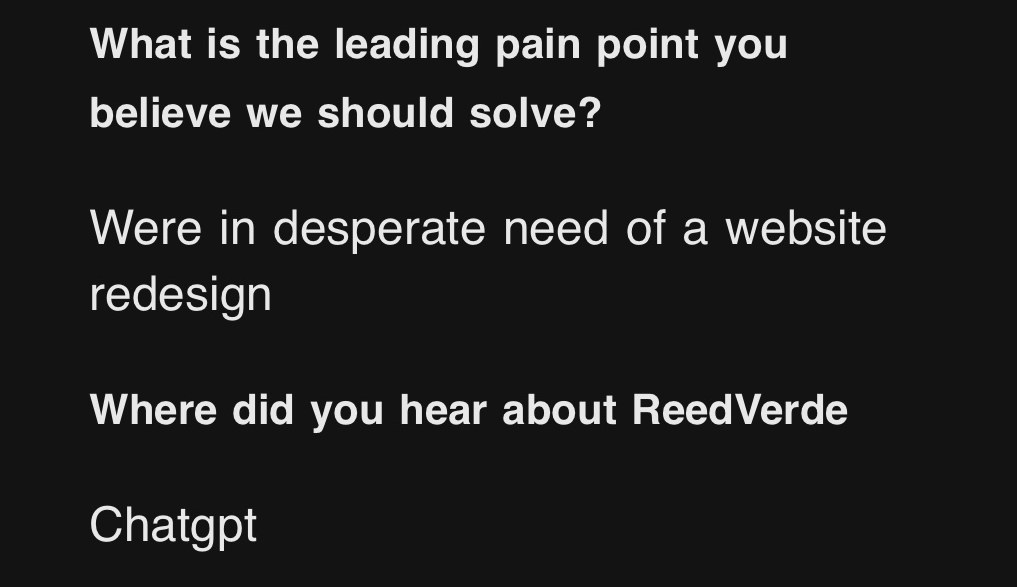
The booking named ChatGPT as the referral source. We don't know whether search results or an ad also played a part. Someone reported finding us through ChatGPT and booked a call.
That's one booking, and it isn't a closed sale. We don't have the prompt or the answer they saw, so I can't credit a single page or change. But it's the discovery path I've been building for, showing up on an actual calendar.
What I mean by dead
The foundations stay. Crawlable pages, clear structure, accurate metadata and useful content still do their job, and you still write in the format of SEO. What dies is selling rankings as the whole plan. More people will ask a question and act on the answer without ever scanning ten blue links.
Google's guidance on AI features says foundational SEO best practices still apply. There is no special AI schema required, and meeting the requirements does not guarantee inclusion.
What we found in the research
Semrush studied more than 500 digital marketing and SEO topics and projected that AI search could send more visitors to websites than traditional search by early 2028, and sooner if Google makes AI Mode its default. It's a forecast for that topic set, not proof for every industry. (Semrush, July 2025)
Pew Research Center tracked the browsing of 900 U.S. adults in March 2025. With an AI summary on the page, people clicked a traditional result on 8% of visits, compared with 15% without one. They clicked a link inside the summary on 1% of visits. (Pew, July 2025) Cloudflare puts it simply: answer engines "read your page and hand the user a summary," so the visit isn't needed. (Cloudflare, July 2026)
Semrush's respondents reported an execution gap. Semrush surveyed 481 marketers, business owners and SEO professionals, and only 22% said their SEO and AI search work was fully integrated across strategy, execution and reporting. (Semrush, June 2026) Those are survey answers, not website counts. The gap is still the opening.
SEO, AEO and GEO
SEO helps search engines find and understand your pages. AEO, answer engine optimization, makes your expertise useful for the specific questions customers ask. GEO, generative engine optimization, is about being the general authority on your subject, so an AI building an answer has a reason to cite you. They overlap, and the last two sit on top of the first.
Why waiting costs you
Clear positioning takes thought. Useful answers come from real experience you have to write down. Technical fixes and measurement take work. Starting now gives you months of real inquiries to learn from. Starting later gives you a deadline.
How eVerde helps
eVerde starts with who you serve and the questions they bring. We turn your real expertise into service pages and answers, connect your claims to evidence, and keep your business information consistent everywhere it appears. We check crawlability, server rendered content, metadata, canonicals and structured data. We connect being found to a clear contact or booking path, then measure referrals, inquiries and what happens next. And we start with the smallest useful step before proposing a bigger build.
Nobody can promise an AI will recommend you. We can make your business clear enough that it has a reason to.
Start with an Exploration Call.
Build Forward. Not Over.